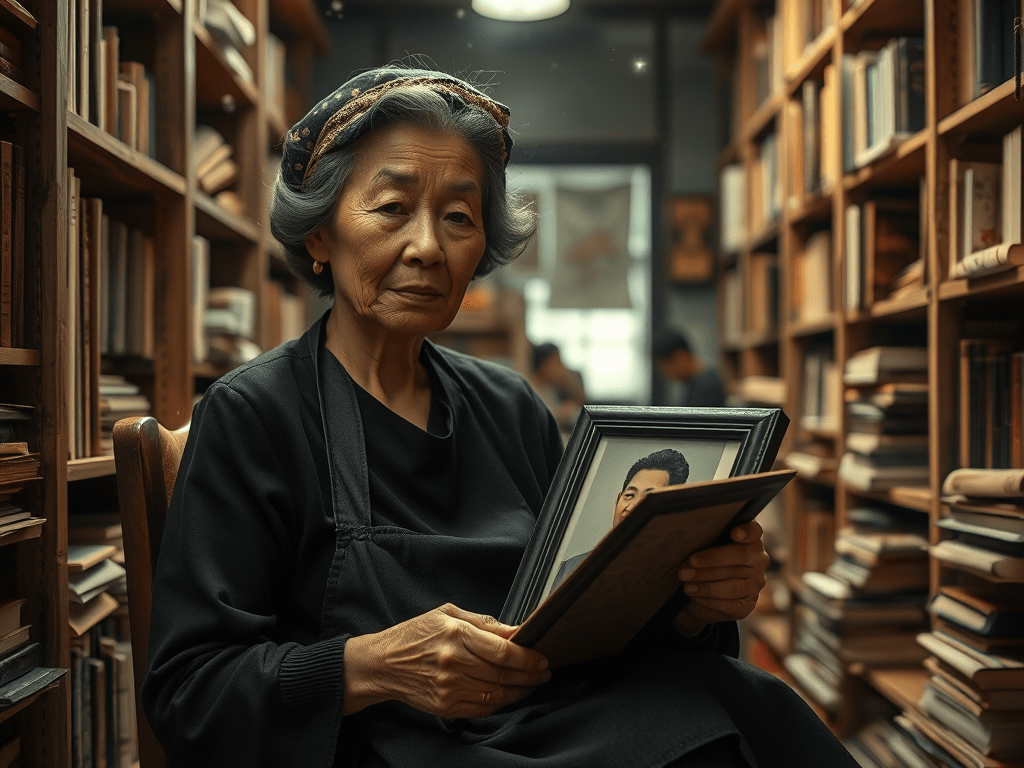
Tears fell as Madam Butterfly was being handcuffed and taken away by the police.
How she got to this point, she didn’t even know.
At 54, Madam Butterfly had long settled into her quiet rhythm. She wore black every day—practical dresses with fitted leggings beneath—and every morning, before unlocking the library doors, she would gently adjust the framed photo of her late uncle. He had saved her once, long ago, when she was spiraling. Back then, angry and aimless, she never imagined she’d one day find peace among worn-out shelves and dust motes of sunlight.
Her uncle had handed her the library key and, with it, a chance to rebuild. She never forgot that. And now, she tried to offer that same grace to others.
That was why she created “Tuesday Free Reads,” a day when anyone—especially young people—could borrow any book without cost, no ID, no overdue slips. Books, she believed, were not just entertainment. Unlike the passivity of screens, they activated something primal—imagination, empathy, possibility.
That’s how she met Martha.
Martha Beekman was a college student in her twenties with frizzy hair, mismatched earrings, and a buzzing energy that filled every corner of the room. She had been a regular for over a year. Warm, talkative, always diving into a new book, she treated the library like her second home.
Madam Butterfly smiled at her, nodded politely, even engaged her in short conversations—but truth be told, she rarely listened closely. Martha rambled, hopped from thought to thought, and Madam Butterfly, always trying to preserve the quiet of the space, didn’t always catch what the girl was saying.
Until now.
Because Martha was missing.
Two inspectors, Inspector Larry and Inspector Magoo had arrived that morning, interrupting Madam Butterfly’s sacred 4 p.m. green tea ritual. Vivi, her Cavalier spaniel, barked once and then curled protectively near her ankles as the conversation grew tense.
“We’re asking about a woman named Martha Beekman,” one of the inspectors said. “She’s been missing for 5 days.”
Madam Butterfly froze.
She remembered Martha’s hopeful voice. “I’m writing something,” she had said once, fiddling with the hem of her sleeve. “Short stories for kids who feel stuck. You think this place would ever host a reading?”
At the time, Madam Butterfly had nodded politely, filed it under friendly chatter, and returned to cataloguing returns. But now, the memory stung. Martha wasn’t just talk. She was trying to give something back. To offer others the same hope the library had given her.
As the inspectors spoke, Madam Butterfly’s breath tightened. They asked for records, surveillance, any details of Martha’s visits. She complied, quietly, her hands trembling as she opened drawers and clicked through logs. She looked at the books Martha had borrowed – The Bedrock Tales, The Future of Flintstones, Fuzzy Logic.
Fuzzy Logic being her last book she had returned before her disappearance. In that book the inspectors had found a letter in an envelope with a address on it.
Inspector Magoo held the thin envelope between two gloved fingers.
“Do you recognize this, Madam Butterfly?”
She squinted at the handwriting. It was Martha’s, no doubt about it—curved and slightly slanted, always written in blue ink.
“It looks like something she might’ve left behind,” she said carefully. “Martha had a habit of tucking notes into books.”
“There’s an address on it. Do you know anyone living there?”
She shook her head slowly. “No. I don’t. But Martha… she used to talk about visiting someone. I didn’t ask who.”
Inspector Larry leaned forward, notebook open. “You didn’t ask?”
“She talked a lot,” Madam Butterfly replied, softly. “And I… I didn’t always listen closely.”
A pause. The room seemed to shrink in that silence.
“So you held books for her?”
“Yes.”
“And this letter—was it placed by her, or by someone else?”
Madam Butterfly hesitated. “I don’t know. I didn’t check.”
“Then we’ll need to take you in for further questioning,” Inspector Magoo said, already reaching for the cuffs.
Vivi let out a soft whine from under the table. Madam Butterfly bent slowly to stroke his head, then stood, hands ready, heart sinking
What she didn’t say aloud was the gnawing guilt in her stomach.
She had paid attention to the dust on the shelves more than to the girl who came in every week, eyes glowing with stories to tell.
And when they finally placed her in cuffs—on suspicion of obstruction, or perhaps something deeper she didn’t yet understand—Madam Butterfly didn’t protest. She had spent her life avoiding confrontation, agreeing to things easily, doing what was asked of her out of fear of conflict.
Madam Butterfly had lived the life of a troubled youth in what felt like eons ago, and yet it still clung to her like it was only yesterday. She couldn’t help but wonder if the past was repeating itself.
But this moment… this moment wasn’t about fear.
It was about Martha.
And all the things left unsaid.
 memajuve
Leave a comment