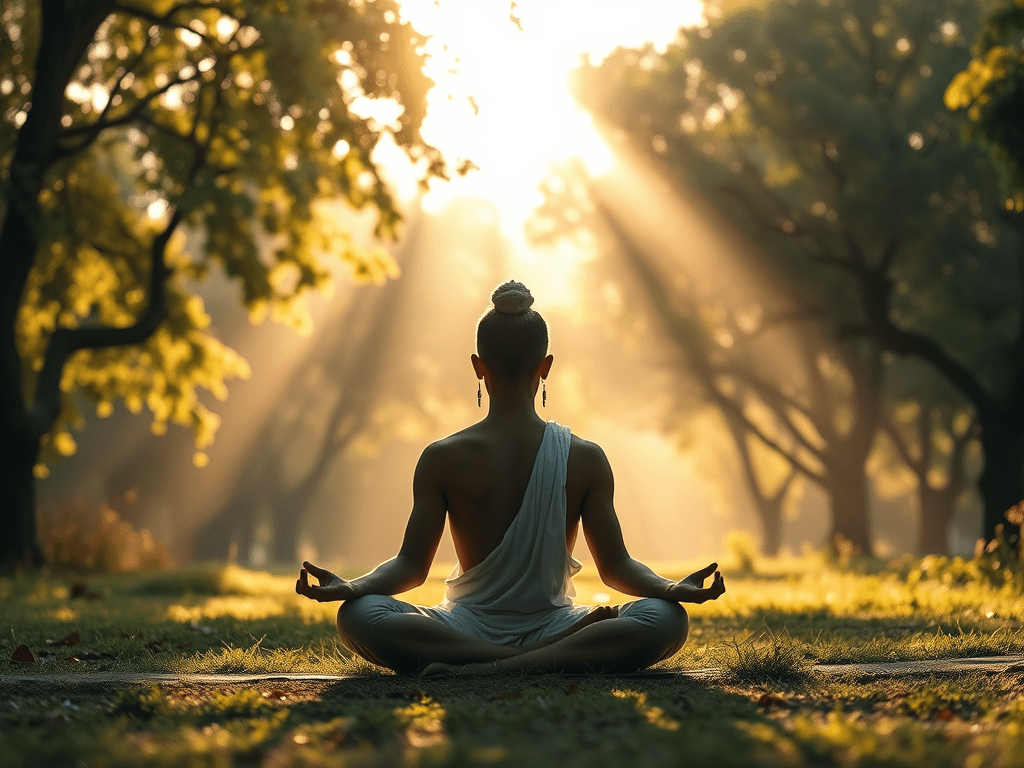
🧘♂️ Understanding Samādhi Pāda: The Essence of Yoga in Patanjali’s First Chapter
The Yoga Sūtras of Patañjali is one of the most profound and concise texts on the philosophy and practice of yoga. It’s made up of four chapters, and the first one is called Samādhi Pāda, which means “Chapter on Meditative Absorption.”
But don’t worry—it’s not as complicated as it sounds. This chapter lays the foundation for the entire path of yoga. Let’s break it down into its essential teachings.
🕉️ What Is Yoga?
Patañjali defines yoga right at the beginning:
“Yogaś citta-vṛtti-nirodhaḥ” (Sūtra I.2)
“Yoga is the stilling of the fluctuations of the mind.”
This means that yoga isn’t just about physical postures—it’s about calming the constant chatter and movement of the mind so that we can experience clarity, peace, and our true self.
👁️ The Seer and the Mind
When the mind becomes still, something amazing happens:
“Then the Seer rests in its true nature.” (I.3)
But when the mind is disturbed:
“At other times, the Seer identifies with the fluctuations.” (I.4)
The “Seer” refers to our true self—pure awareness (called puruṣa). In daily life, we’re often caught up in thoughts, emotions, and sensory experiences. Yoga helps us stop identifying with all that and return to the quiet center of our being.
🌀 What Are the Fluctuations of the Mind?
Patañjali names five types of mental activities (called vṛttis) in Sūtras I.5 to I.11:
- Right knowledge (pramāṇa)
- Misconception (viparyaya)
- Imagination (vikalpa)
- Sleep (nidrā)
- Memory (smṛti)
These are the ways the mind moves. Yoga aims to gently settle these activities.
🔄 How to Calm the Mind: Practice and Detachment
The way to still the mind is twofold:
“Abhyāsa-vairāgyābhyām tan-nirodhaḥ” (I.12)
“Through practice and detachment, the mind’s fluctuations are stilled.”
- Abhyāsa (Practice): Regular, committed effort to focus the mind.
- Vairāgya (Detachment): Letting go of cravings and aversions.
Together, these lead to stability and inner quiet.
🧘♀️ What Is Samādhi?
The chapter introduces samādhi—a state of deep meditative absorption where the mind becomes so still that it reflects pure awareness without distortion.
There are stages of samādhi, including:
- Savitarka & Nirvitarka: With or without mental reasoning
- Savicāra & Nirvicāra: With or without subtle reflection
- Eventually leading to nirbīja samādhi—a seedless, transcendent state beyond thought
This is the ultimate goal of yoga: to reach a place where the mind is completely silent, and the Self shines clearly.
🙏 The Role of Īśvara (The Lord)
Patañjali introduces Īśvara, a special kind of pure consciousness untouched by karma or suffering.
“Īśvara is a special Self, untouched by afflictions, actions, or results.” (I.24)
Meditating on Oṁ, the sacred sound symbol of Īśvara, is given as a powerful practice to steady the mind (Sūtras I.27–I.29).
🚧 The Obstacles on the Path
Patañjali acknowledges that yoga is not always easy. He lists 9 obstacles (I.30), including:
- Illness
- Doubt
- Laziness
- A lack of progress
- Instability in concentration
These are accompanied by symptoms like distress, depression, and irregular breathing (I.31).
🛠️ Solutions: How to Overcome the Obstacles
Patañjali offers practical tools to regain balance and clarity:
Cultivate these attitudes (I.33):
- Friendliness toward the happy
- Compassion for the suffering
- Joy for the virtuous
- Equanimity toward the impure
Other methods include:
- Focusing on the breath (I.34)
- Meditating on inner light (I.36)
- Reflecting on deep sleep or dreams (I.38)
- Choosing any uplifting object of focus (I.39)
These help bring the mind back to stillness.
🌟 The Result: A Transformed Mind
The final sūtras of the chapter describe the refined state of the mind that results from consistent practice:
- The mind becomes clear and one-pointed (ekāgratā).
- The yogi experiences direct knowledge and deep peace.
- Ultimately, the practitioner reaches seedless samādhi—complete freedom from all mental impressions.
✨ In Summary
The Samādhi Pāda is not just for scholars or ascetics. It speaks to anyone who wants to find peace in a noisy world. It teaches:
- What yoga truly is (stilling the mind)
- Why it matters (to know our true self)
- How to practice (with discipline and detachment)
- What we can expect (obstacles, but also transformation)
🧘♀️ Yoga begins not with a posture—but with a quiet mind.
Whether you’re just curious or deep into your practice, the wisdom of Samādhi Pāda is a timeless guide on the inner journey.
 memajuve
Leave a comment