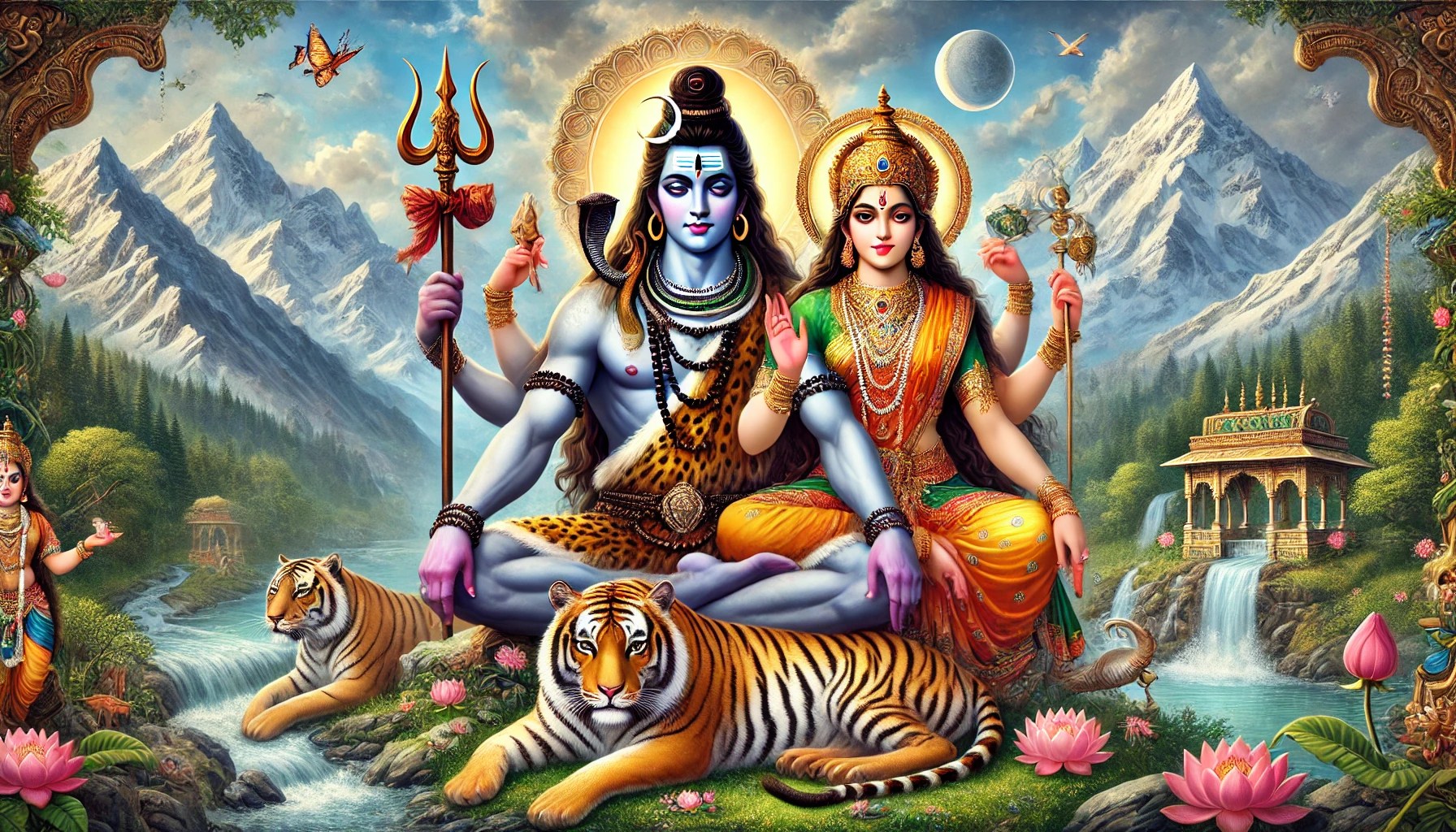
Shiva and Shakti are fundamental concepts in Hindu philosophy and theology, representing powerful and profound aspects of the universe.
- Shiva: Often referred to as the destroyer, Shiva is one of the principal deities of Hinduism. However, his role as a destroyer is not negative; it is part of the cycle of creation, preservation, and destruction necessary for renewal and regeneration. Shiva is also associated with meditation, yoga, and asceticism. He embodies the potential for consciousness and is often depicted as the ultimate reality or Brahman itself in certain philosophies.
- Shakti: Shakti literally means “power” or “energy.” In Hinduism, Shakti is the concept, or personification, of divine feminine creative power, sometimes referred to as ‘The Great Divine Mother’ in Hindu scriptures. She is seen as the force that drives the universe, the energy and power of all the gods, and is inseparable from them. Each of the major gods (such as Shiva, Vishnu, and Brahma) has a female counterpart (Parvati, Lakshmi, and Saraswati, respectively) who is an embodiment of Shakti.
Relationship between Shiva and Shakti
The relationship between Shiva and Shakti is a central theme in many spiritual practices and narratives, symbolizing the interplay of consciousness (Shiva) and energy (Shakti). In many traditions, Shiva without Shakti is said to be like a corpse – without the energy to act or manifest, while Shakti without Shiva has no form or direction. Their union in both myth and iconography symbolizes the merging of dualities, depicting the creation, sustenance, and destruction of the universe.
Philosophical and Symbolic Interpretation
Shiva and Shakti together embody the essential duality in the universe: the passive space of potential existence and the active force that manifests reality. This concept can be seen as analogous to the principles of Purusha and Prakriti, where Purusha is the consciousness (similar to Shiva) and Prakriti is the material force (similar to Shakti).


Leave a comment