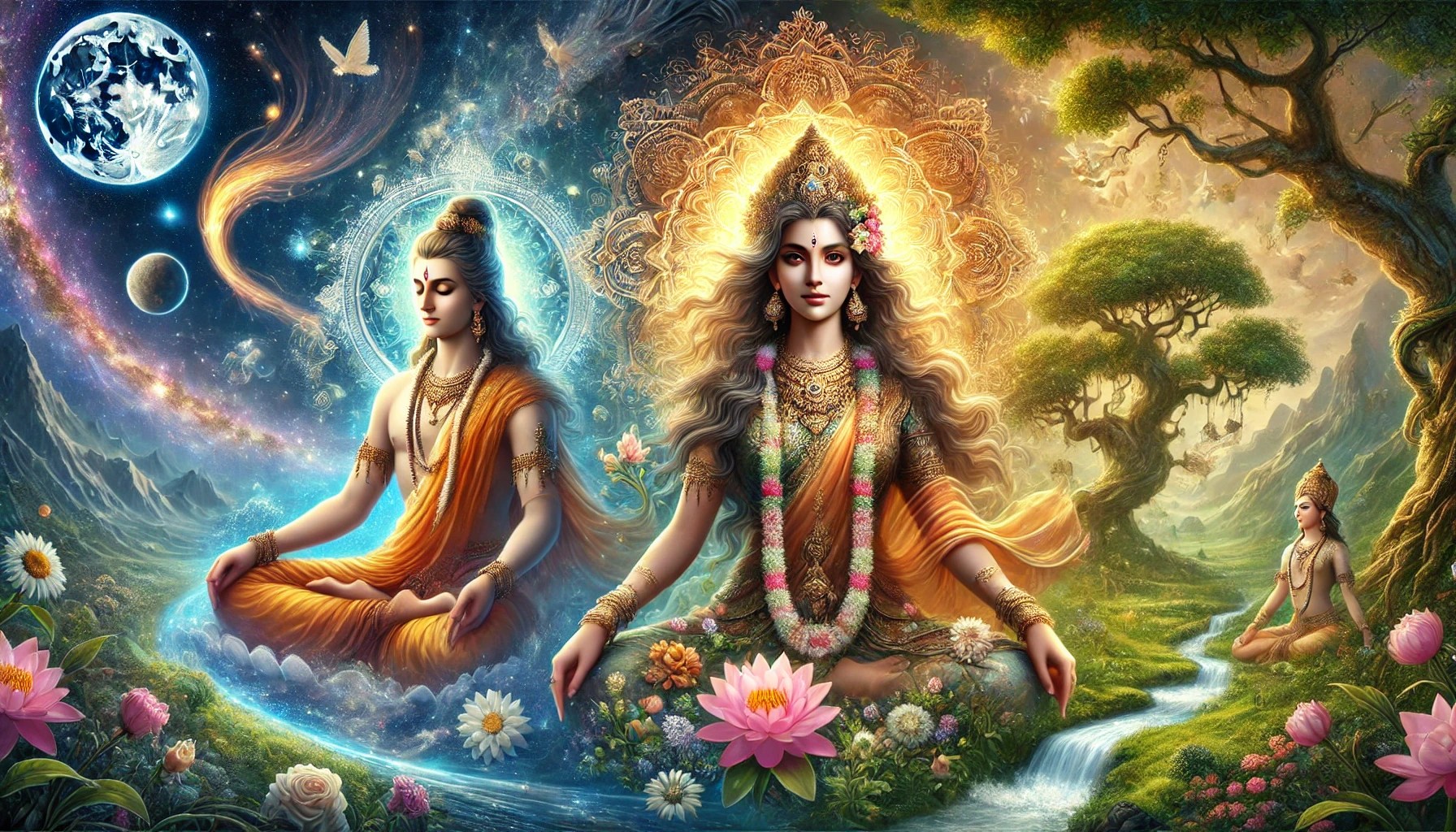
Prakriti: This term refers to the natural world or material reality. In the Samkhya philosophy, Prakriti is the source of the material universe and is considered unconscious, consisting of three fundamental qualities or “gunas”: sattva (balance, harmony), rajas (activity, chaos), and tamas (inertia, darkness). Prakriti is everything that is mutable and perishable in the universe and is seen as the cause of all physical and mental experiences.
Purusha: Contrasting with Prakriti, Purusha is the pure consciousness or the spiritual reality. It is considered eternal, unchangeable, and immaterial. In the philosophical tradition of Samkhya, Purusha is regarded as the true self or soul of an individual, which is beyond all physical and mental suffering. It is a passive observer and does not interact with or influence Prakriti directly but is necessary for consciousness to arise.
Together, these concepts explore the dualistic nature of existence, where Prakriti and Purusha interplay to manifest the universe and life as we perceive it. Purusha is seen as the witness to the dance of Prakriti. The goal of many spiritual practices associated with these philosophies is to realize the distinction between Prakriti and Purusha, thereby achieving liberation (moksha) from the cycle of rebirth and suffering.

 memajuve
Leave a reply to Dharmshala finder Cancel reply