The Body Knew First
How signals travel between body and brain — and how the mind constructs your reality
1. The Body Observes
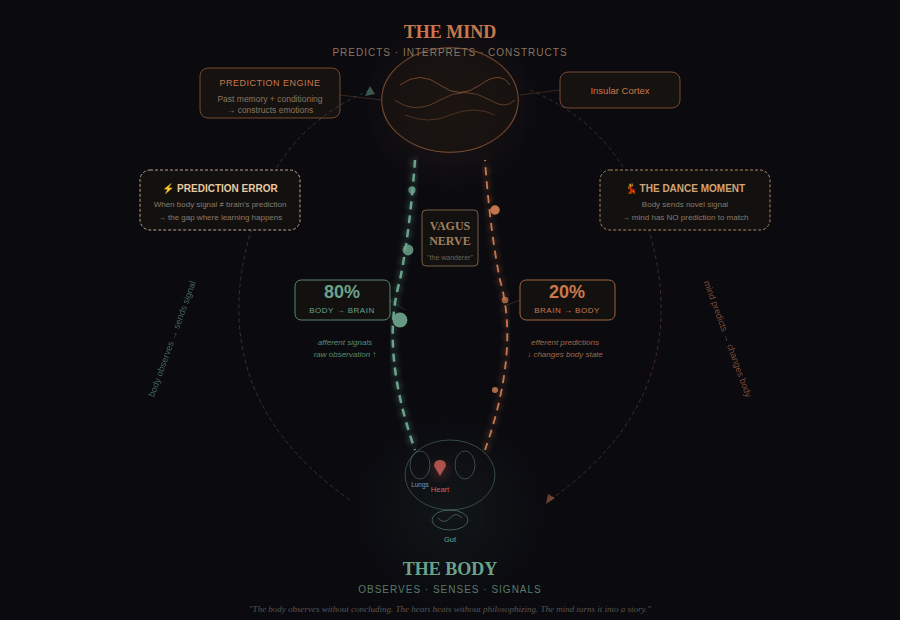
Your heart, gut, lungs, and organs are constantly sending signals up through the vagus nerve to the brain. These signals carry precise, organized information — which organ, which tissue layer, what stimulus.
80% of vagal nerve fibers are afferent — carrying information from body to brain. The body is talking to the brain four times more than the brain talks back. These raw signals are neutral observations — the body’s truth before the mind tells a story about it.
This is the raw observation in Ishika’s equation. Steam rising. Heart beating. Gut sensing. No meaning yet.
2. The Mind Constructs
The brain doesn’t passively receive body signals. It predicts them. Before the body even sends a signal, the brain is already guessing what the body should be feeling — based on past experience, childhood conditioning, and culturally learned concepts.
The insular cortex — the brain’s body-tracking hub — compares incoming signals against predictions. Lisa Feldman Barrett calls the result a constructed emotion. What we experience as “anxiety” or “boredom” isn’t the body’s signal — it’s the brain’s interpretation.
This is the inference — the ghost. The story the mind tells about a moment that no longer exists as it was. Only 20% of vagal fibers carry the brain’s predictions back down to the body.
3. The Loop That Traps
The brain’s predictions don’t stay in the brain. They travel back down the vagus nerve and physically change the body — increasing heart rate, releasing cortisol, tightening the gut. The body then sends those changes back up. The brain reads its own handiwork and says: “See? I was right.”
This is how the child Ishika’s interpretation became physical reality. Her mind decided cooking wasn’t love → body tightened with withdrawal → brain read the tension as confirmation → loop reinforced for years. The inference changed the next observation.
This is why purely cerebral meditation hits a wall. You can observe thoughts, but the body is still carrying decades of the mind’s predictions in its tension, posture, and breathing — and those signals keep feeding the old story.
4. The Dance That Broke Through
When Ishika danced — unscripted, unchoreographed — the body sent signals the brain had no prediction for. Unfamiliar muscle stretches. Altered breathing. A heart rate driven by play, not stress. The brain faced a prediction error it couldn’t resolve with any existing category.
For a moment, there was pure body experience without mental interpretation. The gap between observation and inference — the one she’d been seeking through philosophy — the body found it through movement.
Then the mind grabbed the nearest label: “waste of time.” But the body had already spoken. And if she dances again, the repeated prediction error forces the brain to build a new pathway. The old prediction weakens. The loop rewrites itself.
She used the word “dance” to describe Prakriti and Purusha before she discovered that literal dance was the breakthrough. The body already knew what the mind was theorizing about.
“The body observes without concluding. The heart beats without philosophizing. The gut senses without writing a narrative. The mind is the one that takes the body’s raw signal and turns it into a story.”
 memajuve
Leave a comment