On Tanha — Craving — and the Spoke of the Wheel I First Saw Turning
“With feeling as a condition, there is the arising of craving.”
— The Buddha, Paticcasamuppada
I Noticed Something
It didn’t arrive with fanfare. There was no dramatic crisis, no obvious object of desire. Just a quiet, persistent pull — a kind of inner fidgeting — the desire to find out what “I” want to do next.
I sat with it for a moment. Not acting on it. Not suppressing it. Just — noticing.
And in that noticing, I recognized it: tanha. Craving. One of the central spokes of what the Buddha called the wheel of dependent origination. The wheel that keeps us spinning through cycles of wanting, grasping, becoming, and suffering — so automatically, so invisibly, that most of us never even know it’s turning.
This is the first entry in a series I’m calling The Wheel. Each entry, I go back one more spoke. Today: tanha, craving. The place I first saw the wheel turning in myself.
What Is Tanha, Really?
The Pali word tanha is often translated as craving or thirst. The Buddha described it as an unquenchable thirst — an appetite that can never be fully satisfied. But it’s broader than we usually think. It’s not only craving for pleasure or material things. The Buddha identified three forms:
▸ Kama-tanha — craving for sensory pleasure. The obvious one.
▸ Bhava-tanha — craving for existence, for becoming, for continuing as someone with a direction and identity.
▸ Vibhava-tanha — craving for non-existence, for the unpleasant to end, to not be, to escape.
What I noticed in myself was the second one. Bhava-tanha. Not craving for a thing — but craving for a becoming. The self wanting a next move, a next definition, a next version of itself. The discomfort of simply being without a project.
This is subtler than craving for chocolate or a new phone. It’s the self craving direction for itself. A kind of existential restlessness. The ego scanning the horizon for the next thing to be.
The Wheel and Where Tanha Sits
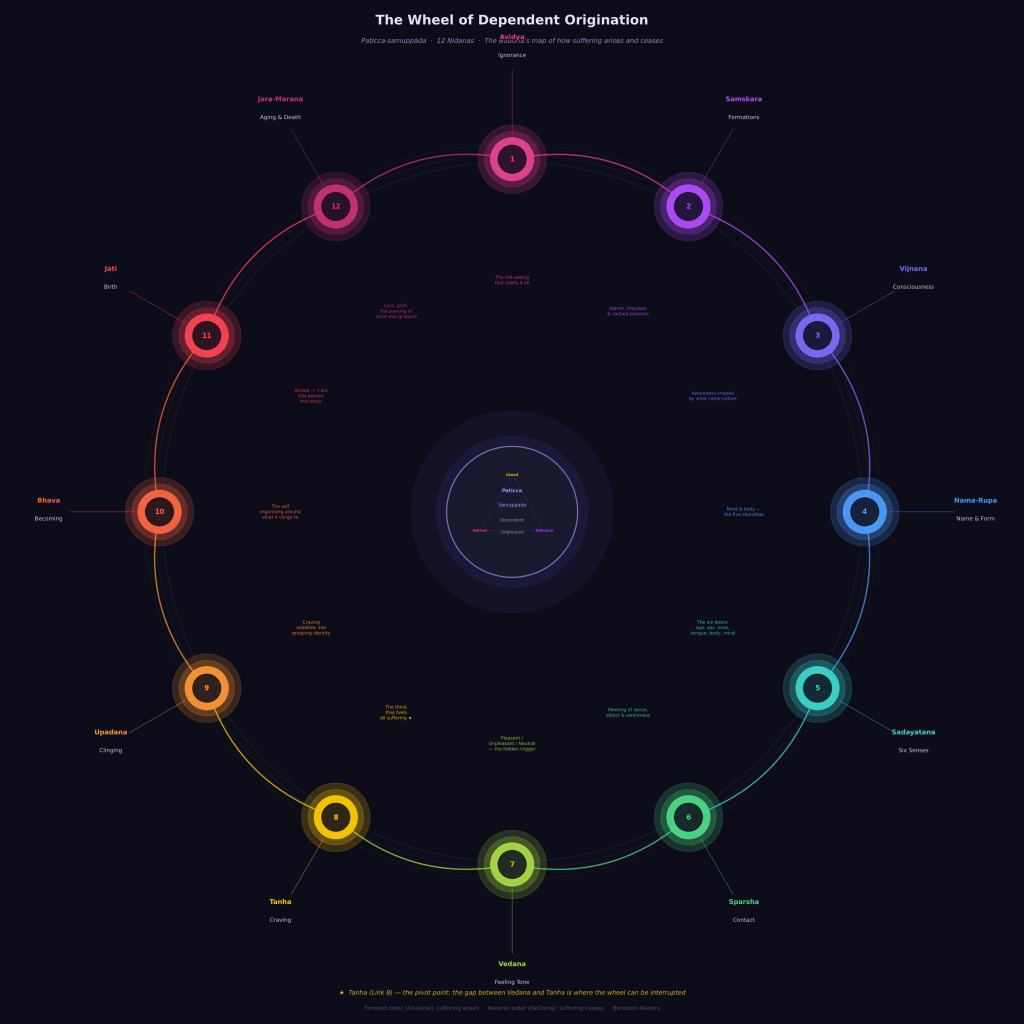
Dependent origination — paticcasamuppada — is the Buddha’s map of how suffering arises and perpetuates itself. Twelve links, each one conditioning the next, looping back to feed the first. The Buddha described it as a wheel. I see it as a circle that keeps drawing itself.
The chain moves like this: Ignorance → Formations → Consciousness → Name and Form → Six Senses → Contact → Feeling Tone → Craving (Tanha) → Clinging → Becoming → Birth → Aging and Death.
Tanha sits at the eighth link. It is not the beginning — ignorance is. But it is the pivot point. Before tanha, the chain is largely pre-conscious — running beneath awareness. After tanha, it becomes action, identity, story. Tanha is where the automatic becomes personal. Where the process says: this is mine, I want this, I need this to be other than it is.
The Buddha called craving the second noble truth — the origin of suffering. Not a moral failing. Not a character flaw. Simply the mechanism by which the wheel keeps turning. If ignorance is the engine, tanha is the fuel.
The Default Program
Think of dependent origination as a default program running in all human beings. Most of us never open the task manager. We just experience the outputs — desire, restlessness, confusion, the persistent sense that something is missing or wrong — without seeing the process generating them.
The underlying drivers — what the Buddha called anusaya, latent tendencies — sit beneath conscious experience, pre-loaded, ready to activate the moment the right conditions appear. Pleasant feeling arises: craving activates automatically. Threat appears: aversion fires. The program runs without our knowledge or consent.
Neuroscience confirms this: decisions register in the brain before conscious awareness of making them. The “I” who claims to have chosen arrives after the fact and takes credit. The Default Mode Network — the brain’s self-narrative system, most active when we’re not fully present — is essentially the neural substrate of this wheel spinning. The restless mind generating stories of wanting and becoming, projecting into futures, replaying pasts, all in service of a self that is itself a construction of the same process.
What I Traced Backwards in That Moment
When I noticed the craving — instead of following it or suppressing it — I stayed with it. And the chain became visible, working backwards:
▸ The craving was toward something — direction, a defined next move.
▸ Beneath the craving was a feeling tone — unpleasantness. The discomfort of not-knowing. Vedana firing.
▸ That feeling tone arose from contact — the mind meeting the open field of no fixed task.
▸ Beneath that — an old formation. A sankhara. A deeply conditioned belief that a self without direction is somehow incomplete.
The entire chain — ordinarily running in milliseconds, below awareness — became visible in a single moment of not immediately acting on what arose.
This is what the Buddha meant by the intervention point between vedana and tanha. The gap between feeling tone and craving. It is razor thin in most moments. But in a moment of real attention — not manufactured stillness, not forced meditation — just genuine noticing — that gap opens.
The Krishnamurti Mirror
Krishnamurti would look at tanha and say: the one who is craving and the craving itself are not two separate things.
When I say “I feel this desire to find direction” — the “I” watching the desire and the desire being watched are the same movement. There is no separate observer standing apart from the craving, nobly examining it. The observer is the craving. The very act of naming it, analyzing it, wanting to understand it — that is still tanha operating, now wearing the costume of the spiritual seeker.
This is the loop within the loop. The wheel has a wheel inside it.
And yet — there was something in that moment of noticing that was not the craving. Not an observer separate from it. But the bare seeing of the craving as craving — without the next move of analyzing, judging, fixing, or indulging. Just: this is craving. This is the wheel turning.
That seeing — however briefly — was not the wheel. It was something in which the wheel was visible.
The Circle and the Vanishing Point
I keep returning to an image. The wheel of dependent origination as a circle. Each spoke a link in the chain, each one feeding the next, the circle perpetuating itself.
What happens when the circle begins to unravel? When link by link, through clear seeing, each spoke loses its charge? The circle contracts. Fewer spokes. Less momentum. Until — it draws toward a single point.
That point is tanha. Craving. The most fundamental fuel.
And when that point vanishes — not suppressed, not destroyed, but seen so completely that it loses its compulsive charge — the circle becomes a line. And the line simply stops.
The Buddha called what remains Nibbana. The unborn. The unconditioned. Not nothingness — but what was always already present beneath the spinning. The stillness in which the wheel was turning, which the turning never touched.
I am nowhere near that point. But I saw the wheel. And seeing it — even for a moment — was the beginning of something. Not a dramatic awakening. Just a small loosening. The tiniest gap between the thirst and the reaching for water.
That gap is everything.
— ◆ —
Next in The Wheel Series:
Entry Two — Vedana: The Feeling Tone Nobody Talks About
 memajuve
Leave a comment