A field report from someone who finds herself doing things.
This afternoon, without deliberating too long, I picked up my ukulele and played.
No plan. No mood board. No productivity timer. The mind wanted to play, the hands followed, and that was that. Afterwards, I thought: why can’t it always be like this? And then I thought: what even was that?
I’ve been turning action over in my head for a while now. Not in the motivational poster way. Not “just do it” and “get out of your comfort zone.” More like — what is actually happening in the body when we move toward something, or don’t? I’ve started to notice there are really three distinct things happening, and I keep confusing them for each other.
I. The reluctant kind
You know this one. There’s something you need to do. You know you need to do it. The mind has made its case, delivered its arguments, shown you the consequences of inaction. And yet the body sits there like it didn’t get the memo.
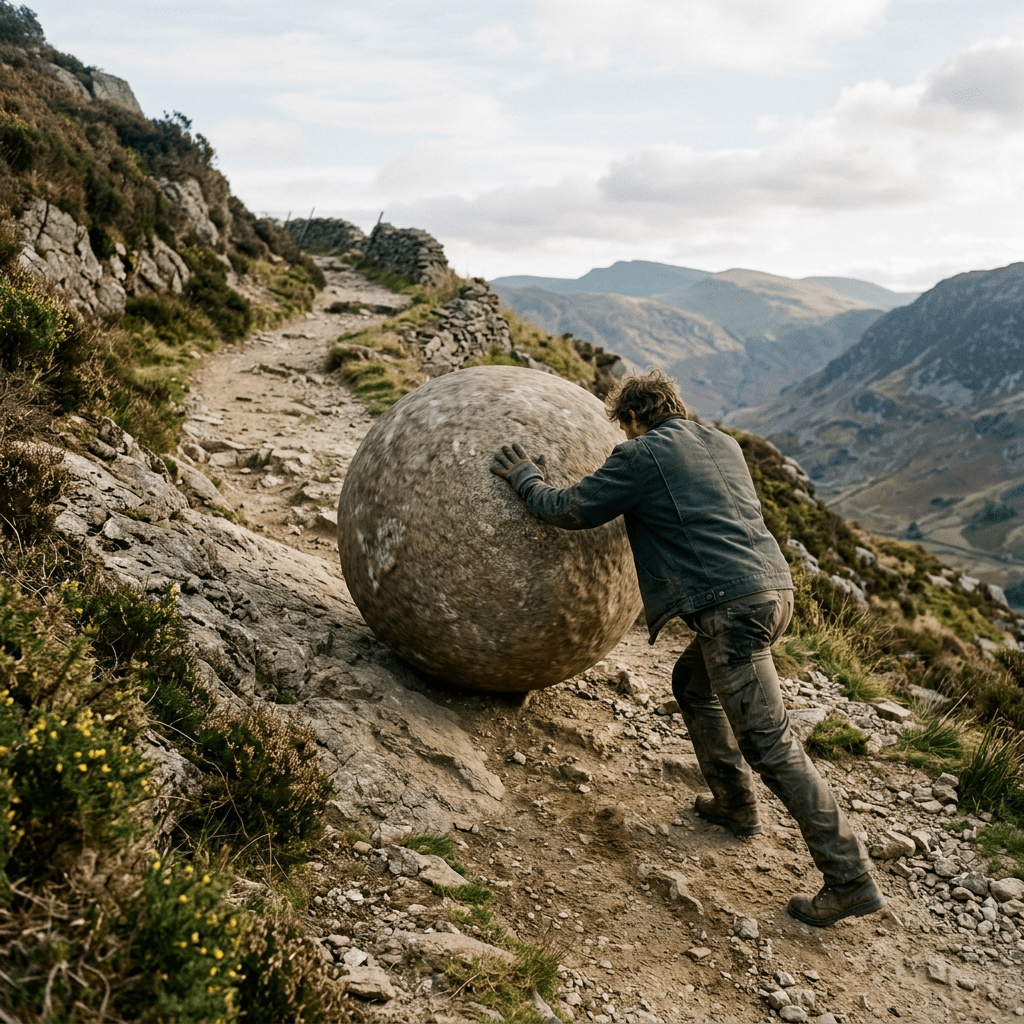
This is the action we talk about most in productivity culture. Push through. Feel the resistance and act anyway. There’s a whole literature on it. It has its uses — things do eventually get done. But it always feels a little like dragging something heavy across carpet. You get where you’re going. You’re just tired.
The Gita has something interesting to say here. Krishna tells Arjuna: you do not have the right to the fruits of action. Do the work because it is yours to do, not because of the result you want. I’ve read this many times. I’m still not sure how to fully inhabit it. But there’s something true in it — the suffering in reluctant action is usually less about the action itself and more about all the imagined futures we’re dragging along with it.
II. The involuntary kind
Then there’s the action that chooses you.
Your name is called and you answer. A crisis unfolds and you handle it. You’re running late and suddenly you’re moving faster than you thought you could. Nobody asked you to deliberate. The situation generated the response.
This kind of action is interesting because it sidesteps the whole conflict. There’s no resistance to overcome because there was no choice to make. The mind never had a chance to weigh in. You were just — already doing it.
I find myself oddly grateful for these moments. Not because they’re comfortable, but because they clarify something: a lot of what I call “not being ready” or “not feeling motivated” is really just the mind inserting itself between me and the next obvious thing.
III. The flowing kind
And then there’s the third kind. The rarest. The one I keep chasing without trying to catch it.
I was writing in my journal this morning — just writing, no structure, no plan — and at some point I noticed I wasn’t monitoring myself. There was no voice tracking the quality, no part of me wondering if I was doing it right. The words were just arriving.
When moments of flow arise, I am truly grateful. Without any structure or method to how I will respond.
This kind of action doesn’t feel like effort in the way we usually mean the word. It’s not effortless exactly — there’s still energy moving through it. But the conflict is gone. There’s no internal negotiation, no convincing required.
The question I keep asking is: can you create conditions for this? Or does trying to summon it kill it? My honest answer: I don’t know. What I’ve noticed is that flowing action tends to show up when I’m not trying to earn anything from it — no audience, no outcome, no proof of productivity. Just the thing itself.
I’m not drawing a conclusion from this. I’m suspicious of essays that end with a neat lesson. But here’s what I think I’m learning: the goal might not be to turn all reluctant action into flowing action. Maybe the more honest project is just — noticing which kind you’re in. Not judging it. Not immediately trying to fix it.
Some days are reluctant-action days. Some things just need to get dragged across the carpet. And some Sunday afternoons, you pick up the ukulele without thinking, and for a few minutes, the whole maze disappears.
That’s enough.


Leave a Reply